


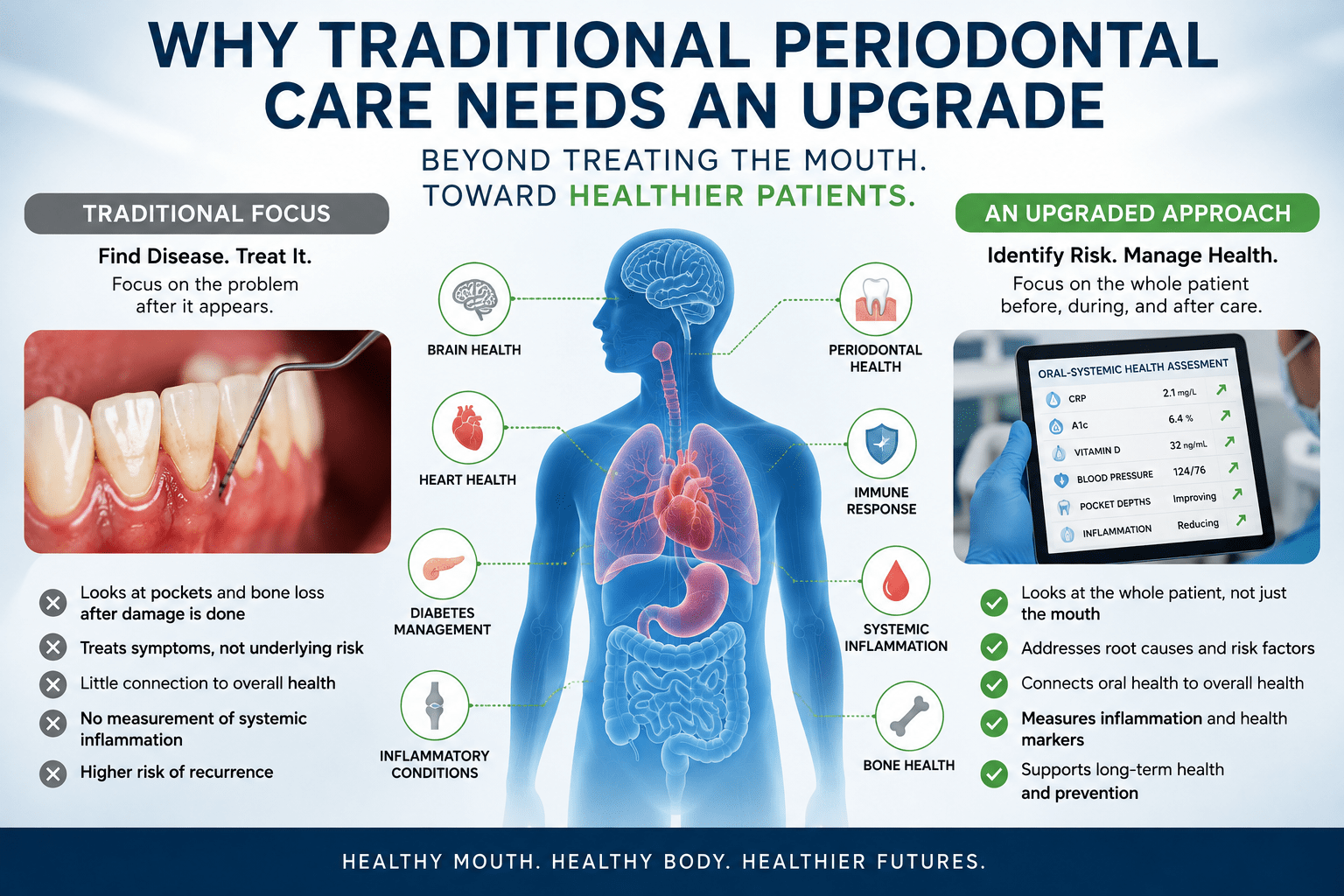
For decades, periodontal care has focused primarily on what can be seen and measured inside the mouth: pocket depths, bleeding, calculus, bone loss, mobility, and other signs of periodontal destruction.
These measurements remain essential.
But today, we understand that periodontal disease should not always be viewed as an isolated dental problem. The inflammation, microbial imbalance, and host response occurring around the teeth and gums may have implications that extend beyond the mouth.
That changes the conversation.
The question is no longer simply:
“How do we treat periodontal disease?”
It is also:
“What is driving this patient’s disease, how might it relate to their overall health, and how do we know whether our treatment is actually changing their risk?”
That is why traditional periodontal care needs an upgrade.
The Traditional Model: Find Disease and Treat It
The conventional periodontal model has served dentistry well.
A patient is examined. Periodontal pocket depths are recorded. Radiographs are evaluated. Bleeding, recession, attachment loss, calculus, and bone loss are identified.
When disease is present, treatment may include scaling and root planing, periodontal surgery, antimicrobial therapy, more frequent maintenance, or referral to a periodontist.
These interventions can be extremely important.
The limitation isn’t necessarily the treatment.
The limitation is stopping there.
A patient’s periodontal condition exists within a much larger biological system.
If we treat the periodontal pocket without considering the patient’s inflammatory burden, metabolic health, immune response, behaviors, microbiome, and systemic risk factors, we may be addressing only part of the problem.
Periodontal Disease Is an Inflammatory Disease
Periodontal disease involves a complex interaction between microorganisms and the body’s immune-inflammatory response.
The bacteria matter.
But so does the patient.
Two people can have similar bacterial exposure and experience very different levels of periodontal destruction. That is because disease progression is influenced by factors including immune response, smoking, diabetes, nutrition, genetics, medications, stress, oral hygiene, and other health conditions.
This means periodontal treatment shouldn’t be based exclusively on removing deposits from tooth surfaces.
We also need to ask:
Why is this particular patient susceptible to disease?
That question opens the door to oral-systemic dentistry.
The Mouth and Body Are Not Separate
The separation between dentistry and medicine is largely a healthcare-system distinction.
Biologically, there is no dividing line at the neck.
The gums are vascular tissue. Periodontal inflammation occurs within a living biological system connected to the rest of the body.
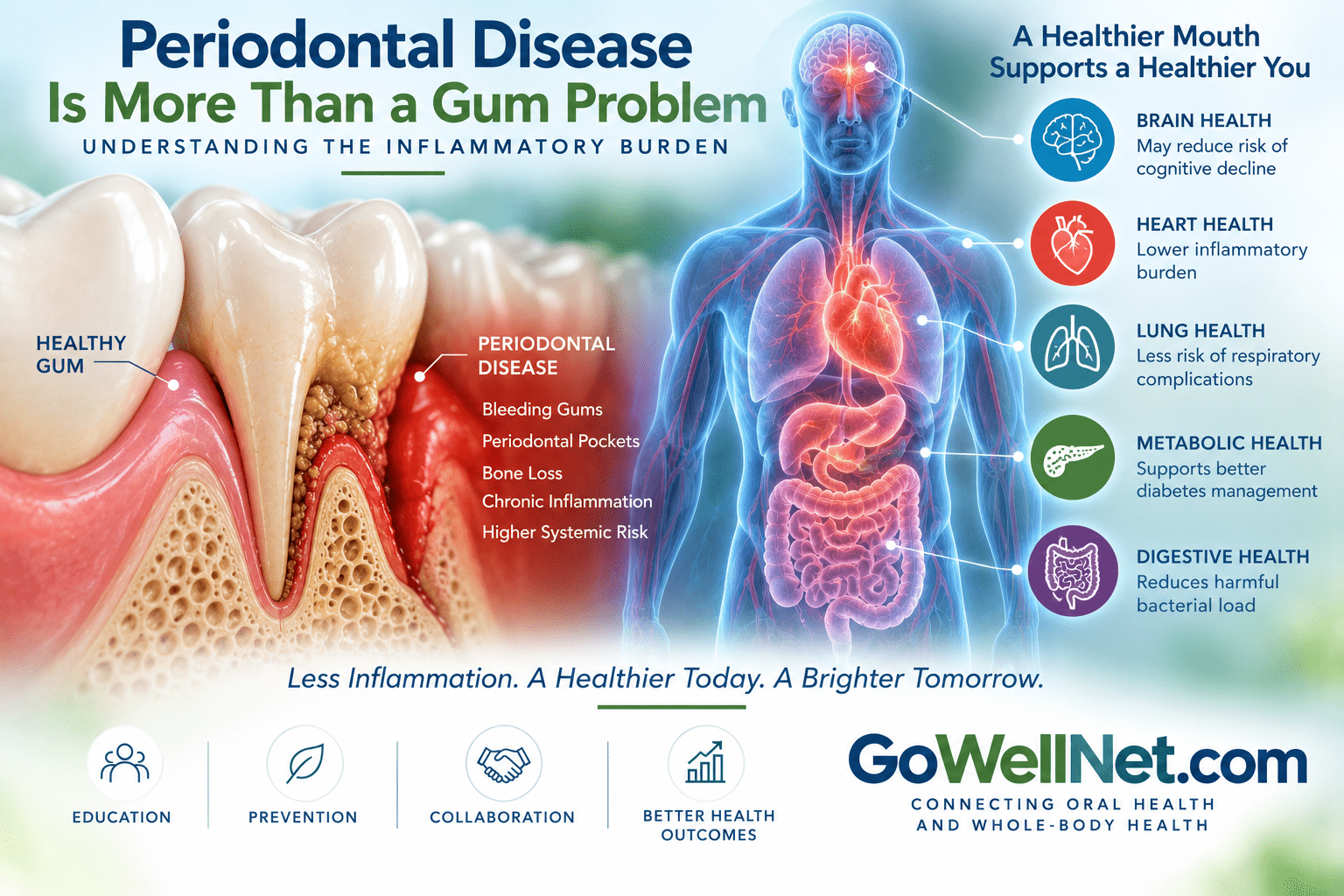
Research continues to examine associations between periodontal disease and systemic conditions, including cardiovascular disease, diabetes, cognitive decline, and other inflammatory disorders.
Association does not automatically mean that periodontal disease directly causes every associated systemic condition.
But the evidence is strong enough that healthcare professionals should pay attention to the shared risk factors, inflammatory pathways, and bidirectional relationships involved.
Diabetes provides one of the clearest examples.
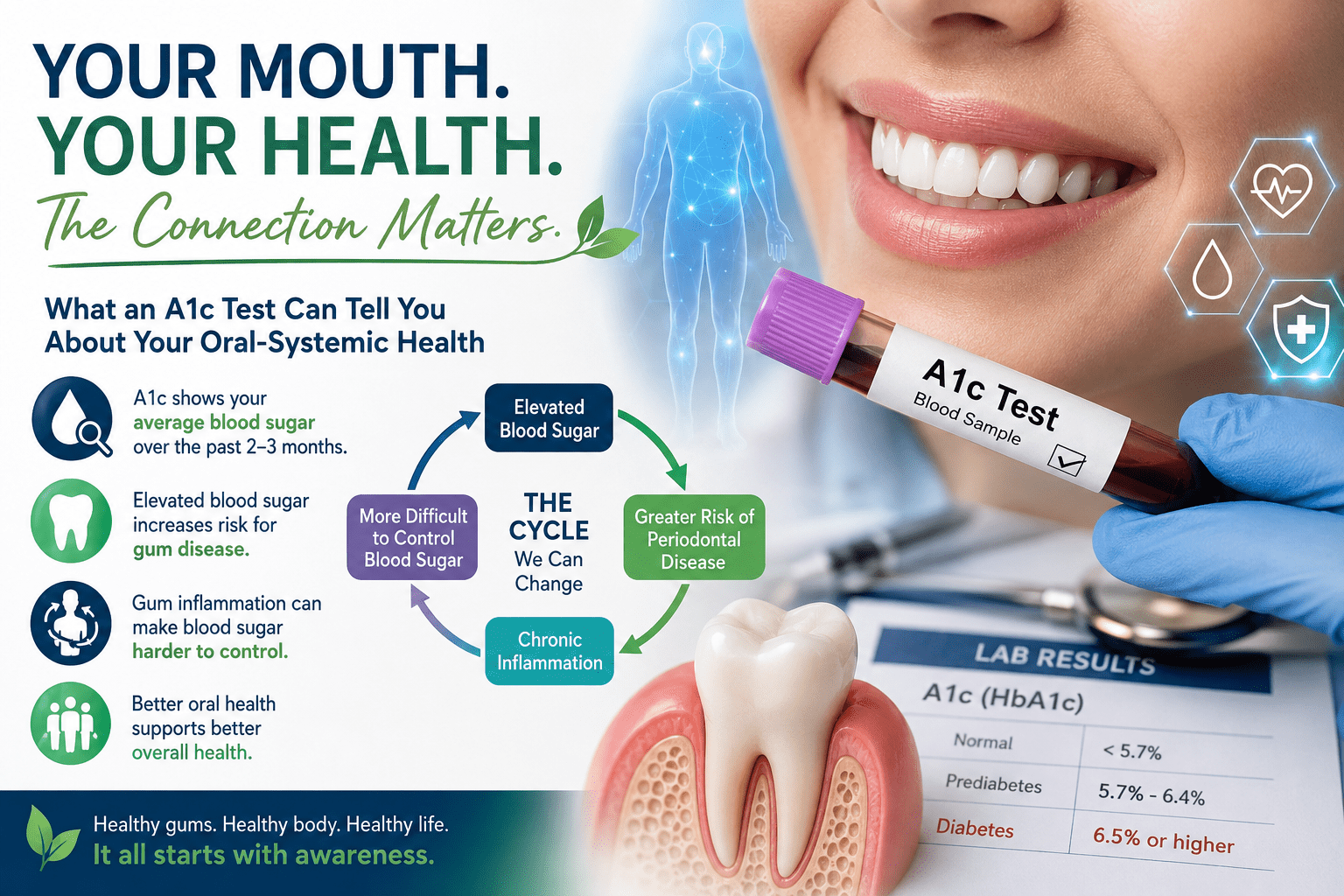
Poor glycemic control can make periodontal disease more difficult to manage, while periodontal inflammation can complicate the overall inflammatory burden of a patient with diabetes.
That is no longer simply a dental conversation.
It is a health conversation.
Upgrade #1: Measure More Than Pocket Depths
Pocket depths tell us what is happening around the teeth.
They don’t necessarily tell us what is happening throughout the patient.
An upgraded periodontal assessment can incorporate additional information when appropriate, including:
- Comprehensive medical history
- Blood pressure
- Glycemic status and A1c
- Inflammatory markers such as C-reactive protein (CRP)
- Vitamin D status
- Smoking and vaping
- Medications
- Nutrition and lifestyle factors
- Salivary or microbial testing
- Family and health history
Not every patient requires every test.
The objective is to stop viewing periodontal measurements in isolation and begin looking for patterns.
A six-millimeter pocket is important.
A six-millimeter pocket in a patient with poorly controlled diabetes, elevated inflammatory markers, smoking history, and cardiovascular risk tells us much more.
Upgrade #2: Identify the Patient’s Risk Before Treatment
Dentistry traditionally identifies periodontal destruction after it has occurred.
Bone has already been lost.
Attachment has already been lost.
Bleeding has already developed.
What if we became better at identifying the conditions that allow disease to progress before additional destruction occurs?
That requires shifting from a repair model toward a risk-management model.
Instead of asking only:
“What procedure does this patient need?”
Ask:
“What conditions need to change for this patient to become healthier?”
The answer may include periodontal therapy, but it may also require collaboration with the patient’s physician, improved glycemic control, smoking cessation, nutritional changes, better home care, microbial management, or other interventions.
Upgrade #3: Treat the Biology, Not Just the Calculus
Removing calculus and disrupting pathogenic biofilm remain fundamental components of periodontal therapy.
But successful long-term management requires creating an environment in which health can be maintained.
Depending upon the patient’s condition and the clinician’s training, comprehensive therapy may incorporate technologies and protocols designed to improve bacterial reduction, inflammation control, tissue response, and home maintenance.
The important principle is not that every office must adopt a particular device or technique.
It is that periodontal therapy should have a measurable biological objective.
Treatment shouldn’t end when the procedure is completed.
The next question should be:
Did the patient get healthier?
Upgrade #4: Measure the Response
This may be one of the biggest opportunities in periodontal care.
Dentistry frequently measures disease before treatment but doesn’t always measure enough of the patient’s biological response afterward.
If bleeding decreases, pocket depths improve, inflammation is reduced, home care improves, and relevant health indicators move in a favorable direction, we have evidence that the strategy is working.
If those things do not improve, we need to ask why.
Perhaps pathogenic biofilm remains.
Perhaps the patient’s home care isn’t sufficient.
Perhaps glycemic control remains poor.
Perhaps smoking continues.
Perhaps another source of inflammation is present.
Measurement turns periodontal therapy from an event into an ongoing health-management process.
Upgrade #5: Collaborate With Medicine
Imagine a dental office identifying a patient with significant periodontal inflammation who also reports uncontrolled diabetes or cardiovascular risk factors.
Should that information stay inside the dental chart?
Increasingly, the answer should be no.
With appropriate patient consent and professional protocols, dental professionals and medical professionals have an opportunity to communicate about shared patients.
The dentist and hygienist may see patients more frequently than their physician does.
That gives the dental team an important opportunity to recognize potential risk, educate the patient, encourage appropriate medical evaluation, and become part of a broader prevention strategy.
Dentists don’t need to become physicians.
Physicians don’t need to become dentists.
They need to communicate.
Upgrade #6: Make the Patient Part of the Team
Periodontal disease cannot be managed successfully through professional treatment alone.
What happens during the hundreds of days between dental visits matters enormously.
Patients need to understand that bleeding gums aren’t simply an inconvenience.
They need to understand why periodontal disease may recur.
They need to know how their systemic health, nutrition, smoking, blood sugar, medications, oral microbiome, and daily home care may influence their periodontal condition.
When patients understand the why, they are more likely to participate in the how.
Education transforms periodontal care from something being done to the patient into something being accomplished with the patient.
From Periodontal Treatment to Oral-Systemic Health Management
The future of periodontal care isn’t about abandoning traditional dentistry.
It is about building upon it.
We still need excellent periodontal charting.
We still need radiographs.
We still need skilled hygienists.
We still need scaling and root planing, periodontal therapy, specialists, and appropriate maintenance.
But we can add another layer:
Assess the whole patient.
Identify risk.
Treat disease.
Measure the response.
Collaborate when necessary.
Create a long-term strategy for maintaining health.
That is the upgrade.
GoWellNet: Helping Practices Make the Transition
Understanding oral-systemic health is one thing.
Implementing it consistently across an entire dental practice is another.
The challenge is turning knowledge into repeatable systems that dentists, hygienists, assistants, administrators, and patients can actually follow.
GoWellNet helps dental professionals bridge that gap by providing education, assessments, implementation strategies, team development, and practical systems designed to integrate oral-systemic thinking into everyday patient care.
Because the future of dentistry isn’t simply about finding more disease.
It’s about recognizing risk earlier, connecting the mouth to the whole person, and creating a culture of prevention.






Leave A Comment
You must be logged in to post a comment.