


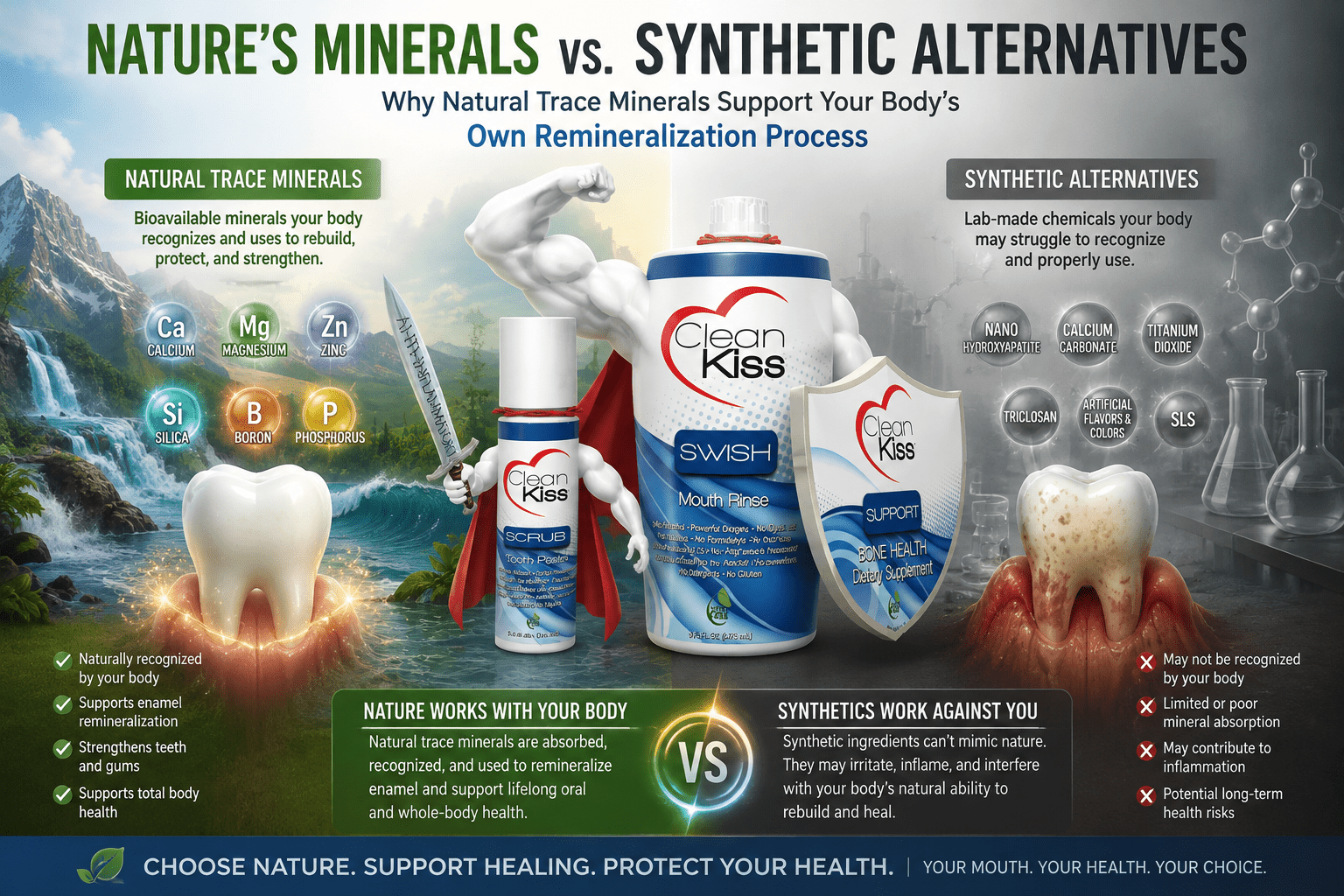
For years, oral care innovation has focused on creating new technologies to repair teeth. One of the latest trends is nano-hydroxyapatite, a laboratory-produced mineral designed to mimic the natural crystals found in tooth enamel.
It has shown promise in helping remineralize early enamel lesions and reduce tooth sensitivity.
But there is another approach that is much older—and much more natural.
Instead of asking, “How can we build a better synthetic enamel?”, perhaps we should ask:
“How can we give the body the natural minerals it needs to repair itself?”
Your Teeth Were Designed to Repair Themselves
Your teeth are not lifeless structures.
Every day, your enamel loses tiny amounts of minerals through eating, drinking, and bacterial acids. Fortunately, your body has an incredible repair system built into every healthy mouth.
It’s called saliva.
Healthy saliva constantly bathes your teeth with calcium, phosphate, magnesium, and dozens of trace minerals that naturally replace minerals lost from enamel. This process, known as remineralization, occurs thousands of times each day.
Nature designed this system long before toothpaste existed.
What Are Trace Minerals?
Trace minerals are naturally occurring elements found in whole foods, spring water, sea minerals, and healthy soils. Although the body needs only small amounts of them, they play essential roles in maintaining strong teeth, healthy gums, and bone.
Important trace minerals include:
- Calcium
- Phosphorus
- Magnesium
- Zinc
- Copper
- Manganese
- Boron
- Silica
Together, these minerals help:
- Build and maintain strong enamel
- Support healthy jawbone and dental implants
- Activate enzymes involved in tissue repair
- Maintain healthy saliva
- Support immune function
- Help regulate inflammation
Rather than acting only on the tooth surface, trace minerals support the body’s natural ability to protect and repair the entire oral environment.
Nano-Hydroxyapatite: A Different Approach
Nano-hydroxyapatite (nHA) is made from microscopic particles of calcium phosphate that resemble the mineral found in enamel.
When used in toothpaste, it may:
- Help reduce tooth sensitivity
- Fill microscopic defects in enamel
- Support remineralization of early enamel lesions
- Smooth the tooth surface
These are promising benefits, and research continues to evaluate its effectiveness.
However, nano-hydroxyapatite is a manufactured ingredient that works primarily on the surface of the tooth. It does not replace the need for the body’s ongoing biological processes that maintain oral health.
Working With Biology Instead of Around It
Imagine your teeth as a garden.
Nano-hydroxyapatite is like patching a damaged section of a garden wall.
Trace minerals are like nourishing the soil, providing water, and creating the conditions for healthy plants to grow.
One repairs a specific spot.
The other supports the entire ecosystem.
Healthy teeth depend on much more than enamel alone. They require healthy saliva, healthy gums, healthy bone, a balanced oral microbiome, and the nutrients that allow the body to function as it was designed.
Nature’s Blueprint for Oral Health
Every tooth begins with minerals supplied by the body.
Every day, saliva delivers minerals back to the enamel.
Every bone supporting your teeth depends on minerals.
Every enzyme involved in tissue repair requires minerals.
This is why nutrition matters just as much as brushing.
If the body lacks the building blocks it needs, even the best oral care products have limitations.
The Meditz Method Perspective
The Meditz Method emphasizes treating the cause, not simply the symptom.
Strong teeth are not created by a single ingredient. They result from an environment where the body can do what it was naturally designed to do.
That’s why our Clean Kiss Scrub toothpaste only uses natural minerals to strengthen tooth enamel. Check out https://cleankiss.com/shop
That means supporting:
- A balanced oral microbiome
- Healthy saliva
- Adequate Vitamin D
- Proper calcium and phosphorus metabolism
- Magnesium and trace minerals
- Healthy nutrition
- Reduced inflammation
- Regular professional dental care
These factors work together to promote lifelong oral and systemic health.
A Balanced View
Nano-hydroxyapatite and trace minerals are not necessarily competing approaches.
Nano-hydroxyapatite may provide localized enamel repair and sensitivity relief for some people.
Trace minerals, on the other hand, provide the natural nutritional foundation that supports healthy teeth, gums, bone, and saliva throughout the body.
Many people choose to emphasize naturally occurring trace minerals because they work with the body’s existing biological systems rather than relying solely on a manufactured material.
The Bottom Line
Your body already possesses an extraordinary system for protecting and repairing your teeth.
The key isn’t simply adding another coating to enamel—it’s ensuring your body has the natural minerals it needs to maintain that repair system every day.
Nature has been building healthy teeth for thousands of years. Supporting that process with a nutrient-rich diet, healthy saliva, adequate vitamin D, and essential trace minerals may be one of the most effective long-term strategies for maintaining a healthy smile.
Healthy teeth begin with healthy biology—and healthy biology begins with the nutrients nature provides.




Leave A Comment
You must be logged in to post a comment.