


The Inflammation Test That May Be Telling You More Than You Think
What if a simple blood test could provide a window into the inflammation occurring throughout your body—and potentially give your dental team another clue that something is wrong in the mouth?
That test is C-reactive protein, or CRP.
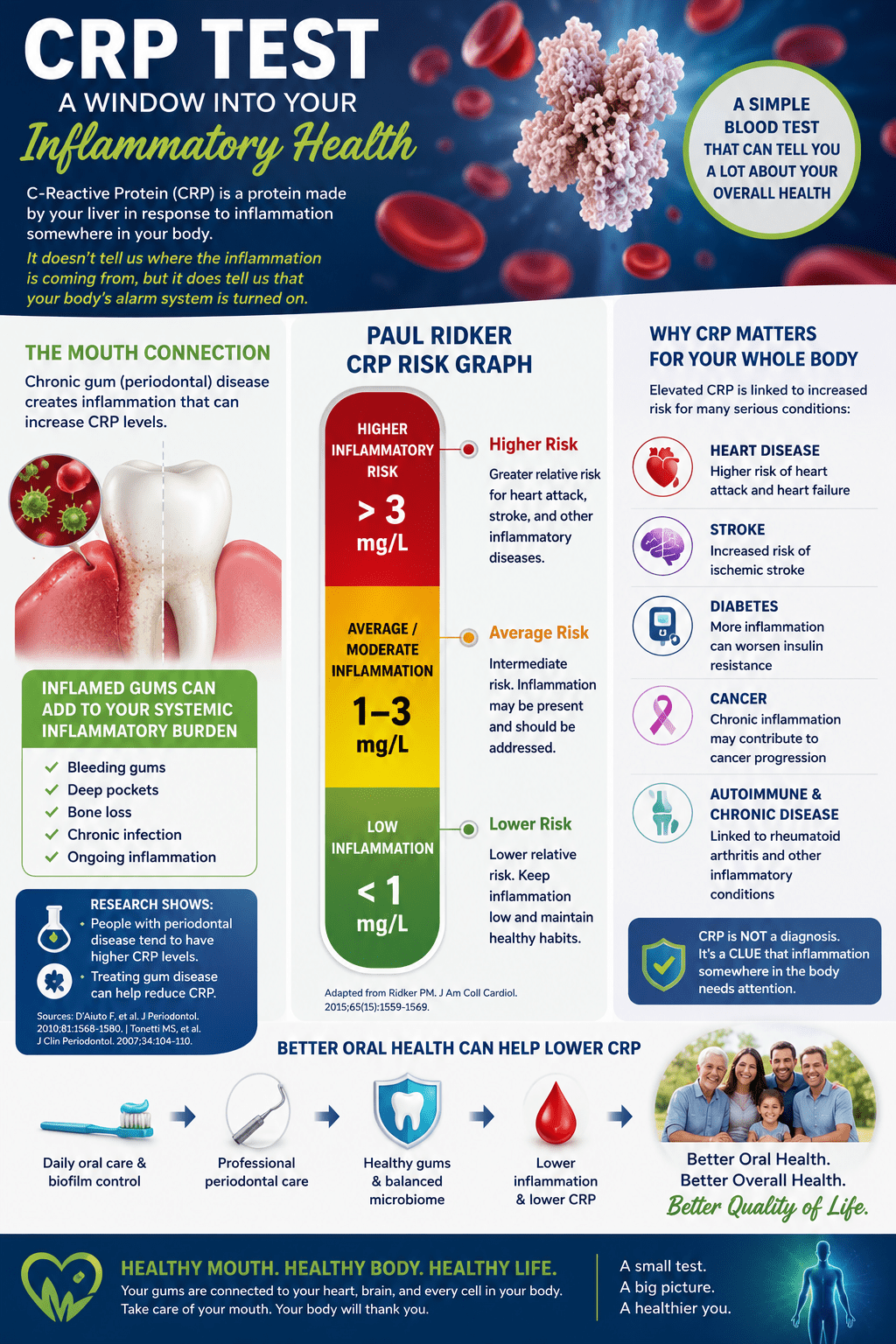
CRP is produced primarily by the liver in response to inflammation. It does not tell us exactly where inflammation is coming from, but it can tell us that the body’s inflammatory system is activated.
For oral-systemic health, that distinction is important.
Periodontal disease is not simply an infection confined to the gums. It is a chronic inflammatory disease that can contribute to an overall inflammatory burden. Research consistently finds that people with periodontitis tend to have higher circulating CRP levels than people without periodontitis.
That means CRP can become an important piece of the larger health picture.
What Exactly Is CRP?
C-reactive protein is an acute-phase protein. When the immune system detects inflammation, CRP production increases.
Think of CRP as a smoke alarm.
The smoke alarm does not tell you whether the smoke is coming from the kitchen, the garage, or a fireplace. It simply tells you that something is happening that deserves attention.
Similarly, an elevated CRP does not diagnose periodontal disease, heart disease, diabetes, or another specific condition.
It tells us:
There is inflammation somewhere in the body, and we need to understand why.
High-sensitivity CRP, or hsCRP, can measure much lower levels of inflammation and is commonly used when evaluating cardiovascular risk.
The Mouth Can Be Part of the Inflammation Story
Periodontal disease begins around the teeth and supporting tissues, but its effects do not necessarily remain local.
The chronic inflammatory response associated with periodontitis can increase systemic inflammatory markers, including CRP. A systematic review and meta-analysis involving dozens of studies found that chronic and aggressive periodontitis were consistently associated with higher CRP and hsCRP levels.
This is one reason the mouth should be considered when evaluating a patient with unexplained or persistent systemic inflammation.
A patient may have:
- Bleeding gums
- Deep periodontal pockets
- Bone loss
- Chronic periodontal infection
- Persistent oral inflammation
while also showing an elevated CRP.
That does not prove that the mouth is the sole cause of the elevated CRP.
But it does raise an important clinical question:
Could oral inflammation be contributing to the patient’s systemic inflammatory burden?
Paul Ridker’s CRP Risk Graph
A major contribution to our understanding of CRP and cardiovascular health has come from the work of Paul M. Ridker, MD, MPH, a Harvard-affiliated cardiovascular researcher.
You may have seen this referred to as the Ridker CRP graph. The name is sometimes mistakenly written as “Richter,” but the researcher is Paul Ridker.
Ridker’s work helped establish commonly used hsCRP categories for cardiovascular risk:
| hsCRP Level | Relative Cardiovascular Risk |
|---|---|
| Less than 1 mg/L | Lower risk |
| 1–3 mg/L | Average/intermediate risk |
| Greater than 3 mg/L | Higher risk |
These categories should not be interpreted as a diagnosis or as a person’s absolute probability of having a heart attack. They are used as one piece of a broader cardiovascular risk assessment.
The Ridker Concept
LOW INFLAMMATION
< 1 mg/L
↓
AVERAGE / MODERATE INFLAMMATION
1–3 mg/L
↓
HIGHER INFLAMMATORY RISK
> 3 mg/L
Ridker’s research demonstrated that hsCRP provides information about cardiovascular risk beyond traditional measurements such as cholesterol and blood pressure.
And this is where oral-systemic dentistry becomes particularly interesting.
What If the CRP Is Elevated?
An elevated CRP should never automatically be blamed on periodontal disease.
CRP can increase because of many conditions, including:
- Acute infections
- Chronic inflammatory diseases
- Obesity and metabolic dysfunction
- Smoking
- Autoimmune disease
- Tissue injury
- Cardiovascular disease
- Periodontal disease
That is why CRP should be interpreted in context.
But when a patient has an elevated hsCRP and significant periodontal inflammation, the mouth deserves consideration as one possible contributor.
Research supports this connection.
A systematic review and meta-analysis found that people with periodontitis generally had higher serum CRP levels than controls. Importantly, periodontal treatment was associated with reductions in CRP, with one large meta-analysis of randomized clinical trials finding an average reduction of approximately 0.69 mg/L at six months after treatment.
That does not mean periodontal treatment “cures” systemic inflammation.
It means that controlling periodontal inflammation may help reduce one potential source of the body’s inflammatory burden.
CRP and the Cardiovascular Connection
Inflammation is now recognized as an important component of cardiovascular disease.
The American Heart Association describes hsCRP as a marker of inflammation associated with increased cardiovascular risk, including heart attack and stroke.
Ridker’s work further demonstrated that hsCRP can provide meaningful risk information even when traditional cholesterol measurements do not appear particularly alarming.
This creates an important oral-systemic-health conversation.
Consider a patient with:
Normal-looking cholesterol
Elevated hsCRP
Bleeding gums
Periodontal pockets
Bone loss
The correct response isn’t to conclude that periodontal disease caused the cardiovascular risk.
The correct response is to recognize that inflammation deserves attention from both the dental and medical teams.
CRP Is Not a Dental Diagnosis
This point is critical.
CRP should not replace a comprehensive periodontal examination.
A periodontal diagnosis still requires appropriate clinical evaluation, including measurements such as:
- Probing depths
- Bleeding on probing
- Clinical attachment levels
- Gingival inflammation
- Recession
- Mobility
- Furcation involvement
- Radiographic bone levels
- Medical and medication history
CRP is an additional piece of information.
It can help move the conversation from:
“How healthy are your gums?”
to:
“How much inflammatory burden may be coming from your mouth—and what does that mean for your overall health?”
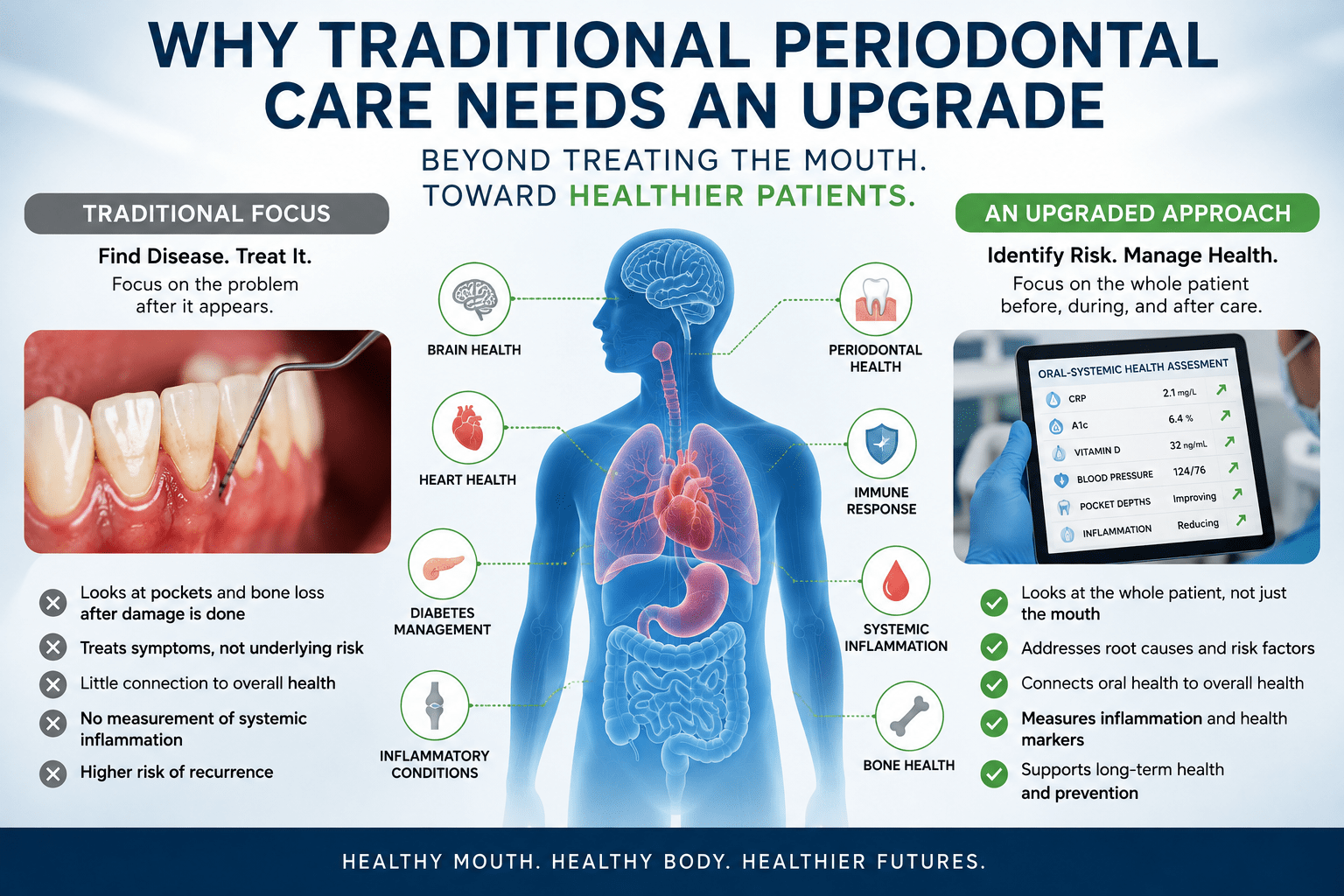
The Oral-Systemic Health Opportunity
This is where dentistry has an enormous opportunity.
The dental office may be one of the few healthcare environments where a patient’s inflammatory condition is being examined directly and repeatedly.
A dental team can see:
Bleeding → inflammation → periodontal pockets → infection → tissue destruction → bone loss
And the medical team may see:
Elevated CRP → metabolic risk → cardiovascular risk → systemic inflammation
The opportunity is to connect those two conversations.
Rather than treating the mouth as an isolated system, we can begin viewing oral inflammation as one component of whole-body health.
What Should We Do With an Elevated CRP?
An elevated CRP is a reason to investigate—not a reason to panic.
A patient with an elevated hsCRP should discuss the result with their healthcare provider, especially if the level is persistently elevated.
The 2025 American College of Cardiology scientific statement notes that hsCRP levels below 1 mg/L, 1–3 mg/L, and above 3 mg/L generally correspond to lower, average, and higher relative cardiovascular risk when interpreted alongside traditional risk factors. It also notes that hsCRP values above 10 mg/L may reflect an acute inflammatory process and generally warrant repeat testing after the acute issue has been considered.
At the same time, the dental team should ask:
“Have we thoroughly evaluated the mouth as a potential source of chronic inflammation?”
The Bigger Picture: Don’t Just Treat the Numbers
CRP is valuable because it gives us a number.
But the number is not the disease.
The number is a signal.
A patient with an hsCRP of 4 mg/L doesn’t need someone to simply say, “Your CRP is high.”
They need someone to ask:
Why?
Could it be periodontal disease?
Could it be metabolic dysfunction?
Could it be smoking?
Could it be an acute infection?
Could there be another inflammatory condition?
Could several factors be contributing simultaneously?
That is the essence of an oral-systemic approach.
The Mouth May Be Part of the Solution
The goal isn’t simply to lower CRP.
The goal is to identify and control the sources of chronic inflammation.
That means helping patients achieve:
- Healthy periodontal tissues
- Reduced periodontal infection
- Effective plaque and biofilm control
- Healthy oral microbiome balance
- Good nutrition
- Healthy blood glucose
- Appropriate vitamin and mineral status
- Healthy blood pressure
- Regular physical activity
- Tobacco avoidance
- Appropriate medical care
Periodontal treatment is one part of that larger strategy.
The evidence increasingly supports the idea that treating periodontitis can reduce systemic inflammatory markers, although CRP should never be viewed as a stand-alone measure of periodontal treatment success or systemic disease.
A New Question for the Dental Office
For decades, dentistry has asked:
“Do you have cavities?”
Then we began asking:
“Do you have periodontal disease?”
Oral-systemic dentistry gives us an even bigger question:
“What is happening in your mouth that could be affecting your health?”
CRP can help open that conversation.
It reminds us that the mouth is connected to the rest of the body through the immune system, inflammatory pathways, blood vessels, and the microbiome.
Your gums may look like a small part of your body.
But inflammation doesn’t always stay small.
The Bottom Line
C-reactive protein is not a diagnosis. It is a clue.
When CRP is elevated, we should look for the source.
When periodontal disease is present, we should recognize that the inflammation may have systemic implications.
And when dentistry and medicine work together, CRP can become more than a number on a lab report.
It can become part of a conversation about preventing disease rather than simply treating it after it occurs.
Medical disclaimer: CRP and hsCRP results should be interpreted by a qualified healthcare professional in the context of the patient’s complete medical, dental, and cardiovascular history. An elevated CRP does not establish that periodontal disease caused systemic inflammation or cardiovascular disease. You can get hsCRP tests from physicians, dentists or from https://cleankiss.com/shop






Leave A Comment
You must be logged in to post a comment.